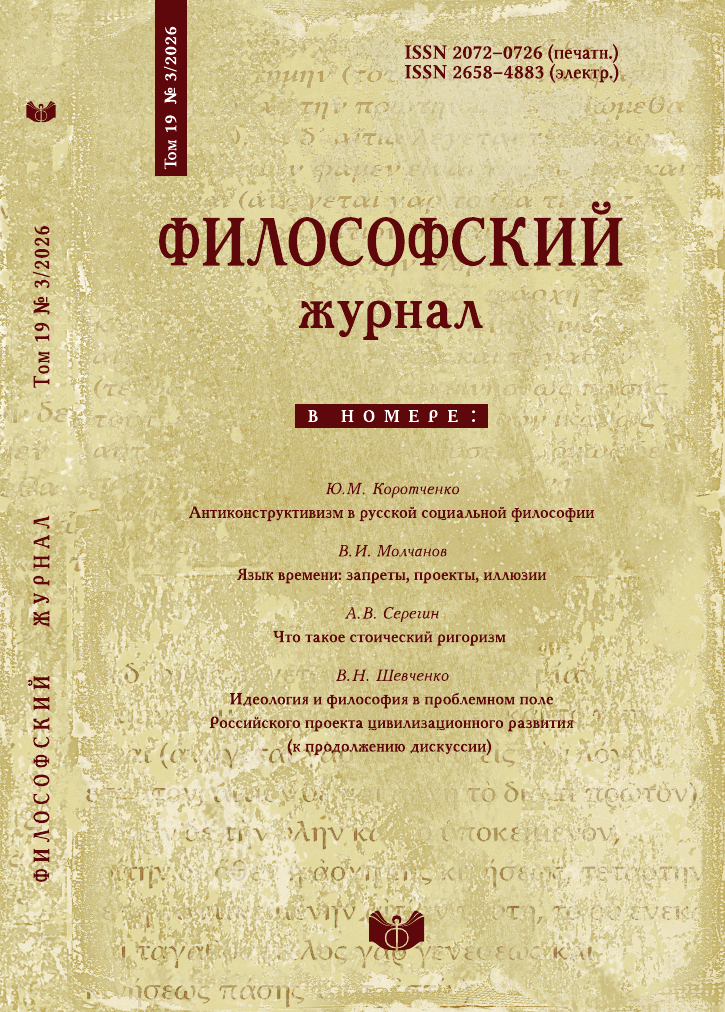
The theme of the “reversal of consciousness” in The Phenomenology of Spirit and the mysteries of the evolution of Hegel’s systemic projects
DOI:
https://doi.org/10.21146/2072-0726-2026-19-3-106-120Keywords:
Hegel’s system of philosophy, The Phenomenology of Spirit, reversal of consciousness, experience, infinity, speculative philosophyAbstract
The article attempts to analyze the “reversal of consciousness” as a moment of “experience”, which is connected with determining the status of object in Hegel’s philosophy. The author aims to demonstrate that attention to this theme helps to clarify the foundations of the evolution of Hegel’s ideas about the nature and composition of the system of philosophy. The analysis of the “reversal of consciousness” discovers the source of the belief in the independence of object and establishes its boundaries. Consideration of the fragments, in which the completion of the formation of the structural units of the text (“circles” of The Phenomenology of Spirit) is represented in the image of “infinity”, allows to conclude that it is necessary for consciousness to overcome the opinion about the “external origin” of the object. As a result, the reader gets the opportunity to comprehend the specifics of the subject of speculative philosophy (Logic), constructed in the course of “experience”. Unlike the subjects of other shapes of consciousness, it is not associated with a “substrate”, since its basis is the “moving contradiction”, that will appear in the image of the first category of “Logic”. The author draws attention to the differences in Hegel’s understanding of the prospects for building a system of philosophy, which are found in the final chapter of The Phenomenology of Spirit and in the Preface, and assesses their correspondence to the logic of the movement of “experience”, which was revealed in the process of considering the “reversal of consciousness” as the expression of the method implemented in The Phenomenology of Spirit. The results obtained contribute to the identification of the factors that influenced Hegel’s choice of the path for building the system of philosophy and clarify the relationship between the system projects that the philosopher developed during his life.