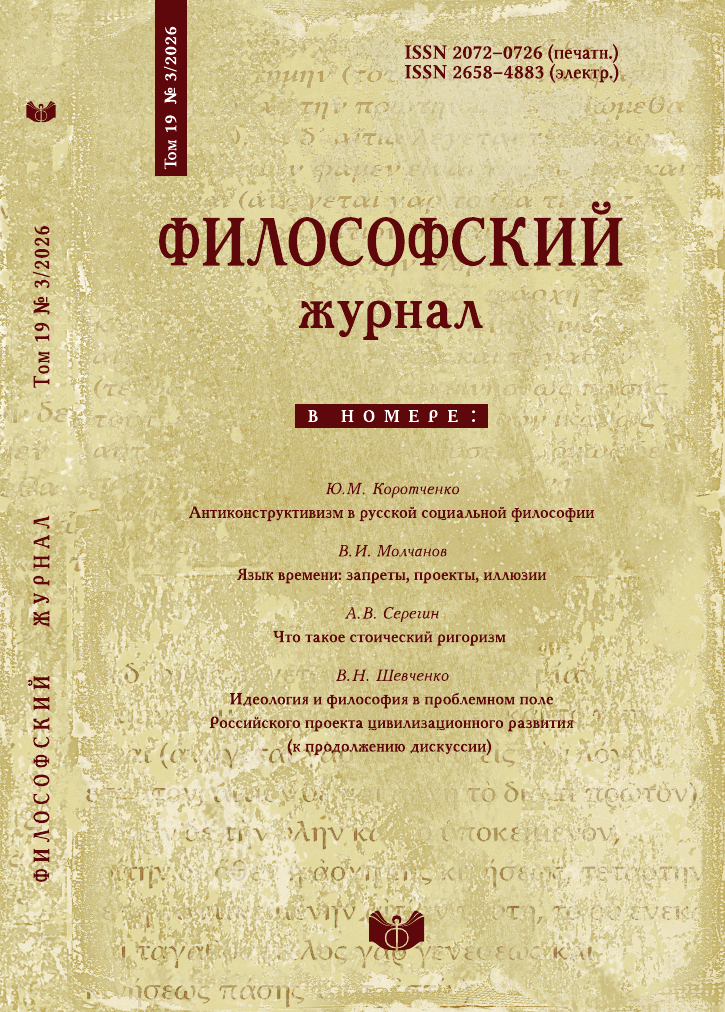
What is Stoic rigorism?
DOI:
https://doi.org/10.21146/2072-0726-2026-19-3-71-86Keywords:
ancient ethics, happiness, good and evil, Stoicism, valueAbstract
At the foundation of Stoic ethics lies a radically rigorist thesis that human happiness or unhappiness depends entirely on moral good and evil, while all varieties of non-moral good and evil are in fact indifferents that are of no importance for happiness or unhappiness. At the same time, the Stoics attribute to some indifferents, which they call “preferred” or “dispreferred,” a certain value or disvalue on the grounds of their conformity or non-conformity with the individual nature of a living being. According to some scholars, this aspect of Stoic ethics significantly mitigates its basic rigorism and shows that the Stoics actually took ordinary objects of human non-moral interests quite seriously. This article offers a critique of this position based on an analysis of Stoic axiology. The central argument of the article concerns the question of what, according to the Stoics, is the ultimate criterion of rationally correct selection among indifferents. On one interpretation, this criterion is precisely their value and disvalue for individual nature, while on another, it is the “right reason” of universal nature. I demonstrate that the second interpretation is preferable because, unlike the first, it aligns well with Stoic eudaimonism. But this interpretation implies that the non-moral value and disvalue of indifferents is not important in itself and thus preserves the radical character of Stoic rigorism.